Every WooCommerce order is a piece of customer data. And most store owners are letting that data sit idle in the WordPress database, disconnected from any sales or marketing system, while their competitors are using the same data to automate follow-ups, recover abandoned carts, identify high-value buyers, and close repeat sales on autopilot.
WooCommerce CRM automation is the bridge between your store’s transaction data and your sales team’s workflow. It takes everything WooCommerce captures — customer details, order values, product purchases, cart abandonments — and pushes it into a CRM in real time, where it triggers the actions that turn one-time buyers into long-term customers.
This guide explains what WooCommerce CRM automation is, which workflow stages to automate first, how to structure the full system, and the fastest way to get it running without custom development.
What Is WooCommerce CRM Automation?
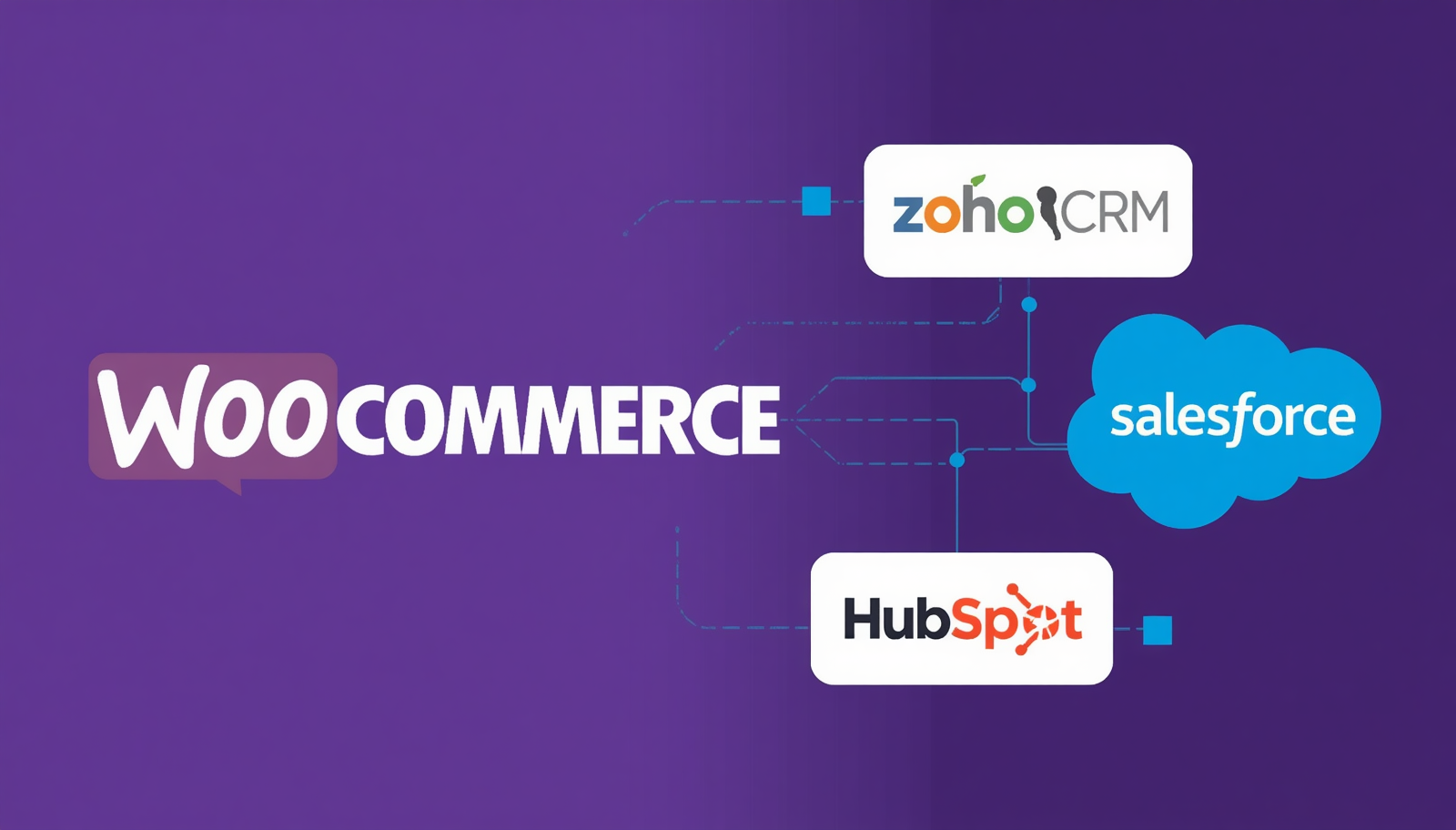
WooCommerce CRM automation is the process of automatically syncing customer and order data from your WooCommerce store into a CRM system — such as Zoho CRM, HubSpot, or Salesforce — and using that data to trigger sales and marketing actions without manual intervention.
In practical terms: a customer places an order on your WooCommerce store. Within seconds, a contact record is created (or updated) in your CRM, a deal is opened with the order value, the customer is tagged based on what they purchased, and a follow-up email sequence begins automatically. Your sales team sees the full order context before making any outreach call — without logging into WordPress or exporting a CSV.
That is the core value proposition: your store and your CRM become one system, not two disconnected tools that require manual data transfer to stay in sync.
The Real Cost of Not Automating Your WooCommerce Sales Workflow
Before looking at what to automate, it is worth being direct about what manual management actually costs:
- Missed follow-ups — Customers who purchase but never hear from you again have no reason to return. Studies consistently show that the probability of selling to an existing customer is 60–70%; to a new one, just 5–20%. If your CRM does not have WooCommerce customers in it, your sales team is starting from zero every time.
- Lost abandoned cart revenue — On average, 70% of shopping carts are abandoned before checkout. Without CRM integration, abandoned cart data never reaches the people or systems that could recover it.
- Wasted sales team time — Sales reps manually logging order details into CRM deals is expensive time spent on data entry instead of selling.
- Poor lead prioritization — Without automated tagging based on order value or product type, your team cannot identify which leads are worth prioritizing. Everyone gets the same level of attention regardless of purchase value.
Each of these problems has a direct automation solution.
5 WooCommerce Workflow Stages to Automate
1. New Customer Sync — Contact Creation on Order Placement
The most fundamental automation. When a new order is placed in WooCommerce, the customer’s name, email, phone number, billing address, and order total are pushed to your CRM automatically and a contact record is created.
If the customer already exists in your CRM, the record is updated with the new order data — no duplicates, no manual merging.
CRM actions triggered: Create Contact, Create Deal (order value), Apply Order Tag, Assign to Sales Rep
2. Order Value Segmentation — High-Value Buyer Tagging
Configure a rule that applies different CRM tags or pipeline stages based on order total. Customers who spend above a defined threshold are automatically flagged as high-value and routed to a dedicated follow-up sequence or sales rep.
Example rule:
- Order total above $500 → Tag: “High Value”, Assign to Senior Rep, Enroll in VIP follow-up sequence
- Order total below $100 → Tag: “Standard”, Enroll in standard post-purchase email sequence
This ensures your highest-value customers receive faster, more personalized attention without requiring anyone to manually review order lists.
3. Post-Purchase Follow-Up — Automated Sequences
Every completed WooCommerce order should trigger a follow-up sequence in your CRM or email platform. A well-structured post-purchase sequence typically includes:
- Day 1: Order confirmation with support contact (builds trust)
- Day 3: Delivery check-in or product setup tips (reduces support tickets)
- Day 7: Review request (builds social proof)
- Day 14: Upsell or related product recommendation (increases average order value)
- Day 30: Re-engagement offer for customers who have not returned (recovers revenue)
Without CRM integration, none of this happens automatically — every follow-up requires manual identification and outreach.
4. Abandoned Cart Recovery — Lead Capture Before Purchase
Customers who add products to their WooCommerce cart and leave without purchasing are warm leads — they have demonstrated intent but encountered a barrier. CRM integration captures this event and triggers a recovery workflow.
CRM actions triggered: Create Lead record with cart value and product, Start abandonment recovery email sequence (1 hour, 24 hours, 72 hours intervals), Apply “Abandoned Cart” tag for sales rep review
For high cart-value abandoners, this can trigger a personal outreach from a sales rep rather than just an automated email — a distinction that significantly improves recovery rates on high-ticket items.
5. Repeat Purchase Tracking — Customer Lifetime Value Management
When a customer places their second, third, or fifth order, your CRM should automatically update their lifetime value, adjust their contact priority, and enroll them in loyalty or retention workflows.
Customers who have purchased three or more times are your highest-value segment. If your CRM does not know they exist as repeat buyers, your retention strategy cannot reach them.
How to Set Up WooCommerce CRM Automation
There are two practical approaches:
Option 1 — No-code automation platform (Make or Zapier) Build a multi-step workflow: WooCommerce order trigger → CRM create contact → CRM create deal → apply tags → start email sequence. Flexible and suitable for custom workflows. Requires a Make or Zapier subscription and ongoing workflow maintenance.
Option 2 — Dedicated WooCommerce CRM connector plugin A purpose-built WordPress plugin handles the full connection — API authentication, field mapping, event triggers, retry queues, and sync logs — entirely inside your WordPress admin. No third-party subscription required, no external platform to maintain, and all customer data stays within your own infrastructure.
The WooCRM Connector is built specifically for WooCommerce CRM integration — supporting Zoho CRM, HubSpot, and Salesforce from a single dashboard with configurable field mapping, event-based triggers, failed sync retry queues, and full activity logging.
WooCommerce CRM Automation: Manual vs. Automated Workflow
| Workflow Stage | Manual Process | With CRM Automation |
| New customer entry | Copy from WooCommerce order to CRM | Instant automatic sync on order placement |
| High-value buyer identification | Manual order review | Automatic tagging by order value rule |
| Post-purchase follow-up | Manual email at rep’s discretion | Automated sequence starts on order completion |
| Abandoned cart recovery | No visibility in CRM | Automatic lead creation + recovery sequence |
| Repeat buyer detection | Manual order history review | Automatic LTV tracking and priority update |
| Sales team briefing | Rep logs in to check WooCommerce | Full purchase history visible in CRM |
Frequently Asked Questions
What is WooCommerce CRM automation?
WooCommerce CRM automation is the real-time synchronization of WooCommerce customer and order data into a CRM system, combined with automated sales and marketing workflows triggered by customer behavior — such as new purchases, abandoned carts, or repeat orders.
Which CRMs work best with WooCommerce?
Zoho CRM, HubSpot, and Salesforce are the most commonly integrated CRMs for WooCommerce stores. Zoho offers the best value for growing businesses; HubSpot excels at marketing automation; Salesforce is the enterprise choice for B2B and high-volume operations. The WooCRM Connector supports all three.
Do I need a developer to set up WooCommerce CRM automation?
Not with a dedicated connector plugin. WooCRM Connector handles the API authentication, field mapping, and event configuration through a WordPress admin interface — no coding required. Custom integrations for complex workflows may require developer involvement.
What WooCommerce events can trigger CRM automation?
The most commonly automated triggers include: new order placed, order status changed (processing, completed, refunded), new customer registration, cart abandonment, and subscription renewal (for WooCommerce Subscriptions users).
Will CRM automation slow down my WooCommerce store checkout?
No. A well-built connector plugin processes CRM API calls asynchronously in a background queue — completely separate from the checkout process. Customers complete their purchase at normal speed; the CRM sync happens in the background moments later.
What data fields can be synced from WooCommerce to a CRM?
Standard fields include customer name, email, phone, billing address, order number, order total, products purchased, order status, and coupon codes. Advanced connectors can also sync custom order meta, WooCommerce Subscriptions data, and product category information for detailed CRM segmentation.
Build Your WooCommerce CRM Automation System Today
Every day without CRM automation is a day your WooCommerce store generates customer data that no one is acting on. New customers are not followed up. High-value buyers are not prioritized. Abandoned carts are not recovered. Repeat buyers are not rewarded.
The fix is a single integration between WooCommerce and your CRM — and it does not require custom development.